
Last Updated on: 2nd February 2024, 11:30 am
Mathematical Indices
Indices
When a continued product of a variable (axaxa … n times) is expressed in an exponential expression an, an is called Exponential Expression, ‘a’ is known as Base and ‘n’ is known as Index. The word Indices is plural of Index.

Laws of Indices
- Expressions with equal Base






- a0 = 1 (irrespective of value of a)
Ex: 50 = 1, 70 = 1
The value of any Real number with power zero is always 1. So, whatever be the Base, if the power (Index) is zero, then the value is always 1.
So, 10= 1, 20=1,  =1,
=1,  =1,
=1,  =1
=1
The only exception is Base cannot be zero. So, we cannot write 00=1 (00≠1), This is undefined.
- ap.bp = (ab)p
72 x 82 = (7×8)2 = 562 - if am=an , where a≠0 and a≠±1 then m=n
So, if the Base is not 1 or -1, the m=n. So, though 15=1 and 17=1, Also, -15= =1 and -17=-1, but we cannot say 5=7. Because this rule is not valid for Base = 1 or -1. - if an=bn , where n≠0, then a=±b
If value two expressions having same base is equal, then the absolute value of the base must be equal. For example 52 and (-5)2 is equal
As explained, this rule is not valid when power is zero,


- If ax = ay, then x=y
When Base is equal (a) and the Index expression (ax & ay) of the equal base (a) is equal (i.e ax = ay ), then the index (x & y) are equal (i.e x=y) - Expressions with equal Index
If xa = ya, then x=y
When Index is equal (a) and the exponential expression (xa & ya) of the equal Index (a) is equal (i.e xa = ya ), then the Base (x & y) are equal (i.e x=y)
Indices : Problems
Indices – Problems & Solutions
Ex. 1 : Evaluate and find the value of 24 x 22 x 52.


Ex. 2 : Evaluate 6ab2c3 ´ 4b−2c−3d.


Step 4 = 24ab0c0d [as b0 = 1, c0 = 1]
Step 5 =24ad.
Ex 3 -1: Hindi Audio – Explain in Hindi
Ex : Multiply x4y3z2 and xy5z-1
Solution: x4y3z2 and xy5z-1
= x4.x .y3.y5.z2.z-1
= x4+1.y3+5.z2-1
= x5.y8.z
Click Here to play a Video on Indices created by a student, explaining the problem, under dVidya Learn and Earn scheme to earn Money.
Find the value of 272/3.
Solution: 272/3 = (33)2/3
= (3)3×2/3
= 32
= 9
Ex – 3-3 Solve 
Solution:
= a3-2b2-4
= a1b-2
= a b-2
=
Ex 3-4 If ax=by=cz and b2=ac, then prove that (1/x) + (1/z) = 2/y
Step 1: Let ax=by=cz = k.(as given)
Step 2: Then a=k1/x (because ax=k, raising both sides to the power of x), In the same way, b=k1/y, c=k1/z
Step 3: Again, b2=ac (Given). So, b2= k2/y so, b2=k1/x.k1/z (because b2=ac)
Step 4 : So, b2= k1/x+1/z =k2/y (because b2= k2/y as derived in step 3)
Step 5: Equating the indices of same base, we get (1/x) + (1/z) = 2/y
Click Here to play a Video on Indices created by a student, explaining the problem, under dVidya Learn and Earn scheme to earn Money
Indices : Problem
Indices – Problems & Solutions

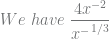
Step 1 = 4[x{−2−(−1/3)}]
Step 2= 4[x(−2 +1/3)]
Step 3= 4x− 5/3 [as the index value (-2 + )=-
)=- ]
]
So, the value of the expression is 4x− 5/3
Ex. 2: Simplify (x1/2y−1/2)4/3 ÷ (x2y−1)−1/3
We have (x1/2y−1/2)4/3 / (x2y−1)−1/3
Step 1 : = [(x1/2)4/3. (y−1/2)4/3] / [(x2.y−1)−1/3]
Step 2 : = [x1/2 x 4/3.y−1/2 x 4/3] / [x2 x−1/3.y−1 x −1/3]
Step 3 : = [x2/3.y−2/3] / [x-2/3.y1/3]
Step 4= x2/3 − (−2/3).y−2/3 − (1/3)
Step 5 = x4/3.y−3/3

Indices : Problem
Indices – Problems & Solutions
Ex. Evaluate (xa y−b)3.(x3 y2)−a.
We have (xa y−b)3.(x3 y2)−a
Step 1= (xa)3.(y−b)3.(x3)−a.(y2)−a
Step 2 = x3a.y−3b.x−3a.y−2a
Step 3 = x3a+(−3a) .y−3b+(−2a)
Step 4 = x0.y−3b−2a
Step 5 = 1.y−2a−3b
Step 6 = y−2a−3b = y-(2a+3b)

Ex. Simply (x m−n)l ´ (x n−l)m ´ (xl−m)n.
The expression (x m−n)l ´ (x n−l)m ´ (x l −m)n
Step 1 = (x ml−nl) ´ (x nm−lm) ´ (x ln−mn)
Step 2 =x ml−nl+nm−lm+ln−mn
Step 3 =x0 = 1.
So, the value of the expression = 1
Indices : Problem
Indices – Problems & Solutions
Ex. Find the value of x if 2x+1 + 3 × 2x−3 = 152.
The equation is : 2x+1 + 3 X 2x−3 = 152
Step 1 : 2x X 2 + 3 X 2x X 2−3 = 152
Step 2 : 2x [(2 + 3 X 2−3)] = 152

![\displaystyle Step4:\text{ }{{2}^{x}}\times \left[ {2+\left( {\frac{3}{{23}}} \right)} \right]=152](https://s0.wp.com/latex.php?latex=%5Cdisplaystyle+Step4%3A%5Ctext%7B+%7D%7B%7B2%7D%5E%7Bx%7D%7D%5Ctimes+%5Cleft%5B+%7B2%2B%5Cleft%28+%7B%5Cfrac%7B3%7D%7B%7B23%7D%7D%7D+%5Cright%29%7D+%5Cright%5D%3D152&bg=ffffff&fg=6a6c6e&s=0 "\displaystyle Step4:\text{ }{{2}^{x}}\times \left[ {2+\left( {\frac{3}{{23}}} \right)} \right]=152")
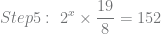

So, 2x=26, or x=6 [As Base are equal, Index are equal]
Ex. Find the value of
![\displaystyle \left[ {{{{\left( {\frac{{{{x}^{b}}}}{{{{x}^{c}}}}} \right)}}^{{\frac{1}{{bc}}}}}} \right]\left[ {{{{\left( {\frac{{{{x}^{a}}}}{{{{x}^{b}}}}} \right)}}^{{\frac{1}{{ab}}}}}} \right]\left[ {{{{\left( {\frac{{{{x}^{c}}}}{{{{x}^{a}}}}} \right)}}^{{\frac{1}{{ac}}}}}} \right]\text{ }+\text{ }25](https://s0.wp.com/latex.php?latex=%5Cdisplaystyle+%5Cleft%5B+%7B%7B%7B%7B%5Cleft%28+%7B%5Cfrac%7B%7B%7B%7Bx%7D%5E%7Bb%7D%7D%7D%7D%7B%7B%7B%7Bx%7D%5E%7Bc%7D%7D%7D%7D%7D+%5Cright%29%7D%7D%5E%7B%7B%5Cfrac%7B1%7D%7B%7Bbc%7D%7D%7D%7D%7D%7D+%5Cright%5D%5Cleft%5B+%7B%7B%7B%7B%5Cleft%28+%7B%5Cfrac%7B%7B%7B%7Bx%7D%5E%7Ba%7D%7D%7D%7D%7B%7B%7B%7Bx%7D%5E%7Bb%7D%7D%7D%7D%7D+%5Cright%29%7D%7D%5E%7B%7B%5Cfrac%7B1%7D%7B%7Bab%7D%7D%7D%7D%7D%7D+%5Cright%5D%5Cleft%5B+%7B%7B%7B%7B%5Cleft%28+%7B%5Cfrac%7B%7B%7B%7Bx%7D%5E%7Bc%7D%7D%7D%7D%7B%7B%7B%7Bx%7D%5E%7Ba%7D%7D%7D%7D%7D+%5Cright%29%7D%7D%5E%7B%7B%5Cfrac%7B1%7D%7B%7Bac%7D%7D%7D%7D%7D%7D+%5Cright%5D%5Ctext%7B+%7D%2B%5Ctext%7B+%7D25&bg=ffffff&fg=6a6c6e&s=0 "\displaystyle \left[ {{{{\left( {\frac{{{{x}^{b}}}}{{{{x}^{c}}}}} \right)}}^{{\frac{1}{{bc}}}}}} \right]\left[ {{{{\left( {\frac{{{{x}^{a}}}}{{{{x}^{b}}}}} \right)}}^{{\frac{1}{{ab}}}}}} \right]\left[ {{{{\left( {\frac{{{{x}^{c}}}}{{{{x}^{a}}}}} \right)}}^{{\frac{1}{{ac}}}}}} \right]\text{ }+\text{ }25")
Step 1
Step 2
![\displaystyle =\left[ {{{{({{x}^{{b-c}}})}}^{{^{{\frac{1}{{bc}}}}}}}} \right]\left[ {{{{({{x}^{{a-b}}})}}^{{\frac{1}{{ab}}}}}} \right]\left[ {{{{({{x}^{{c-a}}})}}^{{\frac{1}{{ac}}}}}} \right]+\text{ }25](https://s0.wp.com/latex.php?latex=%5Cdisplaystyle+%3D%5Cleft%5B+%7B%7B%7B%7B%28%7B%7Bx%7D%5E%7B%7Bb-c%7D%7D%7D%29%7D%7D%5E%7B%7B%5E%7B%7B%5Cfrac%7B1%7D%7B%7Bbc%7D%7D%7D%7D%7D%7D%7D%7D+%5Cright%5D%5Cleft%5B+%7B%7B%7B%7B%28%7B%7Bx%7D%5E%7B%7Ba-b%7D%7D%7D%29%7D%7D%5E%7B%7B%5Cfrac%7B1%7D%7B%7Bab%7D%7D%7D%7D%7D%7D+%5Cright%5D%5Cleft%5B+%7B%7B%7B%7B%28%7B%7Bx%7D%5E%7B%7Bc-a%7D%7D%7D%29%7D%7D%5E%7B%7B%5Cfrac%7B1%7D%7B%7Bac%7D%7D%7D%7D%7D%7D+%5Cright%5D%2B%5Ctext%7B+%7D25&bg=ffffff&fg=6a6c6e&s=0 "\displaystyle =\left[ {{{{({{x}^{{b-c}}})}}^{{^{{\frac{1}{{bc}}}}}}}} \right]\left[ {{{{({{x}^{{a-b}}})}}^{{\frac{1}{{ab}}}}}} \right]\left[ {{{{({{x}^{{c-a}}})}}^{{\frac{1}{{ac}}}}}} \right]+\text{ }25")
![\displaystyle =\left[ {{{x}^{{\frac{{\left( {b-c} \right)}}{{bc}}}}}} \right]\left[ {{{x}^{{\frac{{\left( {a-b} \right)}}{{ab}}}}}} \right]\left[ {{{x}^{{\frac{{\left( {c-a} \right)}}{{ac}}}}}} \right]+25](https://s0.wp.com/latex.php?latex=%5Cdisplaystyle+%3D%5Cleft%5B+%7B%7B%7Bx%7D%5E%7B%7B%5Cfrac%7B%7B%5Cleft%28+%7Bb-c%7D+%5Cright%29%7D%7D%7B%7Bbc%7D%7D%7D%7D%7D%7D+%5Cright%5D%5Cleft%5B+%7B%7B%7Bx%7D%5E%7B%7B%5Cfrac%7B%7B%5Cleft%28+%7Ba-b%7D+%5Cright%29%7D%7D%7B%7Bab%7D%7D%7D%7D%7D%7D+%5Cright%5D%5Cleft%5B+%7B%7B%7Bx%7D%5E%7B%7B%5Cfrac%7B%7B%5Cleft%28+%7Bc-a%7D+%5Cright%29%7D%7D%7B%7Bac%7D%7D%7D%7D%7D%7D+%5Cright%5D%2B25&bg=ffffff&fg=6a6c6e&s=0 "\displaystyle =\left[ {{{x}^{{\frac{{\left( {b-c} \right)}}{{bc}}}}}} \right]\left[ {{{x}^{{\frac{{\left( {a-b} \right)}}{{ab}}}}}} \right]\left[ {{{x}^{{\frac{{\left( {c-a} \right)}}{{ac}}}}}} \right]+25")
Step 3:

![\displaystyle =\text{ }{{x}^{{\left[ {\frac{{{{{^{(}}}^{{ab-ac+ac-bc+bc-ab)}}}}}{{\left( {abc} \right)}}} \right]}}}+\text{ }25=\text{ }{{x}^{0}}+\text{ }25\text{ }=\text{ }1+25\text{ }=\text{ }26](https://s0.wp.com/latex.php?latex=%5Cdisplaystyle+%3D%5Ctext%7B+%7D%7B%7Bx%7D%5E%7B%7B%5Cleft%5B+%7B%5Cfrac%7B%7B%7B%7B%7B%5E%7B%28%7D%7D%7D%5E%7B%7Bab-ac%2Bac-bc%2Bbc-ab%29%7D%7D%7D%7D%7D%7B%7B%5Cleft%28+%7Babc%7D+%5Cright%29%7D%7D%7D+%5Cright%5D%7D%7D%7D%2B%5Ctext%7B+%7D25%3D%5Ctext%7B+%7D%7B%7Bx%7D%5E%7B0%7D%7D%2B%5Ctext%7B+%7D25%5Ctext%7B+%7D%3D%5Ctext%7B+%7D1%2B25%5Ctext%7B+%7D%3D%5Ctext%7B+%7D26&bg=ffffff&fg=6a6c6e&s=0 "\displaystyle =\text{ }{{x}^{{\left[ {\frac{{{{{^{(}}}^{{ab-ac+ac-bc+bc-ab)}}}}}{{\left( {abc} \right)}}} \right]}}}+\text{ }25=\text{ }{{x}^{0}}+\text{ }25\text{ }=\text{ }1+25\text{ }=\text{ }26")
Indices : Problem
Indices – Problems & Solutions
Ex. If 85/3 X 4−4/5 = 2x, Find the value of x
Solution:




![\displaystyle Step\text{ }5\text{ }LHS\text{ }=\text{ }{{2}^{{\frac{{17}}{5}}}}\text{ }\left[ {as\text{ }5-\frac{8}{5}=\frac{{17}}{5}} \right]](https://s0.wp.com/latex.php?latex=%5Cdisplaystyle+Step%5Ctext%7B+%7D5%5Ctext%7B+%7DLHS%5Ctext%7B+%7D%3D%5Ctext%7B+%7D%7B%7B2%7D%5E%7B%7B%5Cfrac%7B%7B17%7D%7D%7B5%7D%7D%7D%7D%5Ctext%7B+%7D%5Cleft%5B+%7Bas%5Ctext%7B+%7D5-%5Cfrac%7B8%7D%7B5%7D%3D%5Cfrac%7B%7B17%7D%7D%7B5%7D%7D+%5Cright%5D&bg=ffffff&fg=6a6c6e&s=0 "\displaystyle Step\text{ }5\text{ }LHS\text{ }=\text{ }{{2}^{{\frac{{17}}{5}}}}\text{ }\left[ {as\text{ }5-\frac{8}{5}=\frac{{17}}{5}} \right]")
So, 217/5 = 2x. [In the equality, as Base is same, i.e, 2, the Index must be equal].

Ex. Find the Value of (am- n)m+n X (an−l)n+l X (al−m)l+m
Step 1: (am- n)m+n X (an−l)n+l X (al−m)l+m
Step 2 : a(m-n).(m+n) X a(n-l).(n+l) X a(l-m) . (l+m)
Step 3 : am²- n²X an²- l² X al²- m²
Step 4 : Here, the sum of the indices = (m2-n2+n2-l2+l2-m2) = 0
Step 5 : So, value of the expression may be written as a0
So, (am- n)m+n X (an−l)n+l X (al−m)l+m = a0 = 1
Indices : Problems
Indices – Problems & Solutions
Ex. If 2x−1 + 2x+1 = 160, find the value of x
2x−1 + 2x+1 = 160.
Step 1 : We may write 2x+1 as 2(x-1)+2, which again may be written as 2x-1X 22.
Step 2 : So, we may rewrite the expression LHS= 2x−1 + 2x+1 = 2x−1 + (2x-1X 22.).
Step 3 : So. the expression may be written as LHS= 2x−1(1 + 22)
Step 4 : So, LHS= 2x−1(1 + 22) = 160 (as given)
Step 5 : So, 2x−1 x (1+4) = 160
Step 6 : So, 2x−1 x 5 = 160
Step 7 : So, 2x−1 =  =32
=32
Step 8: 2x−1 = 25 [In the equality, as Base is same, i.e, 2, the Index must be equal].
Step 9 : So, x-1 = 5, or x = 5+1, or x=6.
Indices : Problems
Indices – Problems & Solutions
Ex. If 3a = 5b = 15c, Find the value of c
Step 1 : Let 3a =5b = 15c =k . So, k=3a or 
Step 2 : 5b =k. So, 
Step 3 : 15c =k, or 

Step 5 : So, k(1/a + 1/b) = k 1/c [In the equality base (k) is same, So, the index value  must be equal]
Step 6 : So, ( +
+  )=
)= ,
,
Step 7 :  = , i.e c=
Indices Short Problem and Solution
Ex. Which Is Greater, 3√5 Or 4√3
Step 1: First, we compute the value of 3√5.
3√5=√5X3X3 (3 is taken from outside the square root to inside square root, So, it is taken twice)
=√45 (the value inside the square root computed)
Step 2: Next, we compute the value of 4√3.
4√3 =√3X4X4 (4 is taken from outside the square root to inside square root, So, it is taken twice)
=√48 ((the value inside the square root computed)
Step 3: As 48>45
So, 4√3>3√5
Click here to play Video for the Problem and Solution
Click here to View Video Problem and Solution
Ex. If ax=by=cz and b2=ac, then prove that  +
+  =
= 
Step 1: Let ax=by=cz = k.(as given)
Step 2: Then  (because ax=k, raising both sides to the power of 1/x), In the same way,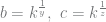
Step 3: Again, b2=ac (Given). 

Step 5: Equating the indices of same base, we get + =
To see PDF

